
OKI, Warganet – In Pedamaran, a district in Indonesia’s South Sumatra province, a simple wetland plant has long been part of everyday life.
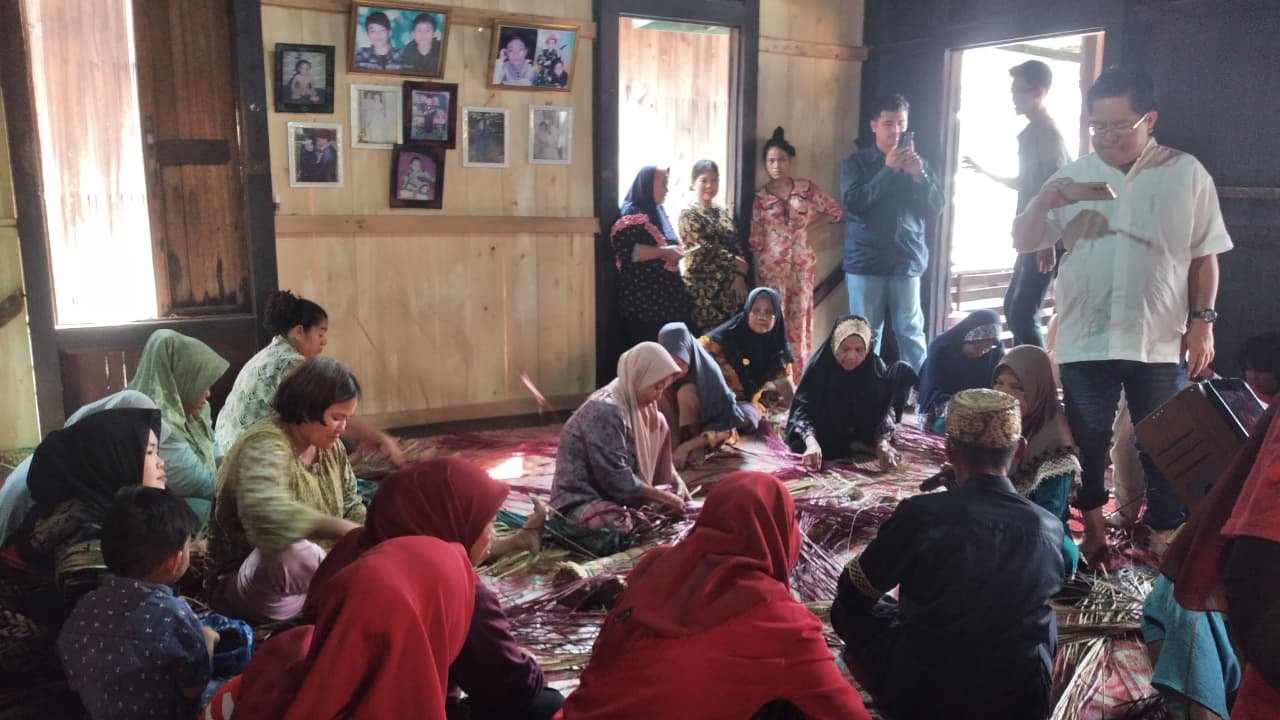
Known locally as purun, the plant is harvested and woven, mostly by women, into mats and household goods. The craft has been passed down through generations, providing families with an additional source of income while preserving a distinctive part of Pedamaran’s cultural heritage.
But the tradition is facing a new challenge — not from a lack of skill, but from a lack of successors.
As younger people increasingly leave rural communities in search of jobs in cities, fewer are interested in learning the painstaking art of weaving purun.
That raises a difficult question: who will keep the tradition alive when today’s artisans are no longer able to do it?
The issue was highlighted during the 2026 Pengabdian Masyarakat Kolaborasi Indonesia (PMKI), a community empowerment initiative involving three Indonesian public universities — Universitas Terbuka (UT), Universitas Sriwijaya (Unsri) and Universitas Airlangga (Unair).
The program was held in Menang Raya Village, Pedamaran, Ogan Komering Ilir, on Friday, Aug. 14, 2026, focusing on product innovation and digital marketing for purun handicrafts.
Rather than simply preserving the traditional craft, the universities are encouraging artisans to rethink how purun can compete in a changing economy.
A Craft That Pays the Bills
For many families in Pedamaran, purun weaving is not merely about preserving tradition.
It is part of the household economy.
Ida Utami Dwi Kurniawati, head of Urang Diri Pedamaran and owner of Galeri Pengerajin Purun Rude Gebol Juai Pedamaran 4, said income from purun products has helped families cover daily expenses and support their children’s education.
“Purun weaving has proven to support family livelihoods. The income is often used for daily needs and children’s education,” she said.
The economic role of the craft also makes the question of regeneration more urgent.
If young people see weaving as a low-paying, time-consuming occupation, the tradition may struggle to survive.
Dr. Gayung Kasuma of Universitas Airlangga said many young people are increasingly choosing jobs in urban areas rather than continuing the craft practiced by their parents and grandparents.
The problem is compounded by the fact that the price of woven products does not always match the time and effort required to make them.
For Gayung, keeping the tradition alive therefore requires more than simply asking young people to continue what their elders have done.
The craft itself must evolve.
From Mats to Modern Products
For generations, the most familiar purun product has been the traditional mat.
But artisans in Pedamaran are now exploring a wider range of products, including bags, wallets, tissue holders, household containers, small prayer mats and goodie bags for events.
Natural dyes are also being introduced to give the products greater visual variety. Turmeric, for example, can be used to create a natural yellow colour.
Dr. Meita Istianda of Universitas Terbuka said innovation is necessary to increase the economic value of purun.
“Purun products need to continue developing so they can create greater added value and improve the welfare of artisans,” she said.
The shift is subtle but important.
The goal is not to abandon the traditional mat. Instead, it is to expand what purun can become.
A traditional material can take on a contemporary identity without losing its connection to the community that created it.
Taking Purun Beyond Pedamaran
The next challenge is finding customers.
Dr. Agustina Bidarti of Universitas Sriwijaya said digital marketing could help artisans reach consumers far beyond their village.
“We hope the products made by the women and artisans here can be marketed online so their market reach can expand,” she said.
Pedamaran’s artisans already have experience selling outside their immediate area.
Ida said their products have reached other parts of Sumatra, including Jambi. Artisans have also participated in exhibitions as far away as Batam and received special orders from institutions and community organisations.
Some have produced purun containers and goodie bags for events.
The experience shows that demand exists.
What remains is to build a stronger bridge between the artisans and a much larger market.
That is where digital marketing could make a difference.
Instead of waiting for customers to visit Pedamaran, artisans can potentially introduce their products directly to consumers through online platforms.
The Problem Starts Before the Weaving
Yet there is another threat that could prove even more fundamental: the availability of purun itself.
Purun grows naturally in wetland areas around Pedamaran. But those ecosystems are facing pressure from land-use changes.
Gayung said some wetland areas are being converted for plantations, including oil palm, rubber and acacia. Other vegetation can also compete with purun in its natural habitat.
Ida expressed similar concerns, pointing to changes in wetland areas and the impact of plantation waste.
If the plant becomes harder to find, artisans could eventually face a shortage of the very material that defines their craft.
In other words, protecting the weaving tradition also means protecting the landscape that makes the tradition possible.
“Hopefully, purun in Pedamaran will remain sustainable, because this is not only about handicrafts. It is also about culture and people’s livelihoods,” Ida said.
Where Technology Meets Tradition
Technology could offer another piece of the solution.
Much of the processing of purun is still done manually, requiring physical effort before the material is ready to be woven.
Ida said the artisans are open to working with Universitas Sriwijaya’s Faculty of Engineering to research and develop equipment that could make the process more efficient.
One possibility is a machine to process or pound purun, reducing some of the labour-intensive work currently performed by hand.
Such technology could help make the craft more attractive as a livelihood while allowing artisans to maintain the weaving skills at the heart of the tradition.
The universities’ role, therefore, is not simply to teach artisans how to sell more products.
It is also about helping them rethink production, technology and the future of their craft.
Protecting a Cultural Identity
Gayung has also suggested pursuing geographical indication protection for Pedamaran’s purun products.
Such protection could strengthen the connection between the product and its place of origin while helping safeguard the identity of a craft that has developed through generations of local knowledge.
For Pedamaran, that identity is deeply connected to culture.
Meita noted that purun mats are not merely economic products. They have also been used in traditional ceremonies, including customs surrounding the birth of a child and wedding ceremonies.
The craft is therefore part of a much larger cultural landscape.
A Tradition Looking for Its Next Generation
Pedamaran’s purun craft is now at a turning point.
The older generation still holds the knowledge needed to harvest, process and weave the plant. But the younger generation is growing up in a different economic environment, with opportunities that extend far beyond the village.
That does not necessarily mean the tradition has to disappear.
But it may need to change.
Better products could create better prices. Digital marketing could open new markets. Technology could reduce the burden of manual processing. Legal protection could strengthen the identity of the product. And efforts to protect wetland areas could help secure the raw material itself.
For the women who have spent years weaving purun, these changes are about more than business.
They are about ensuring that a skill once learned around the household can still have a place in the lives of their children and grandchildren.
Because in Pedamaran, saving purun means saving more than a plant or a traditional mat.
It means protecting a livelihood, preserving women’s economic roles, carrying forward local knowledge and keeping a cultural identity alive.
The future of purun may ultimately depend on whether the next generation can see not only a tradition worth preserving, but a future worth weaving.